

Using WhyTry as a Substance Prevention Program

WhyTry Units:
- Decision-Making & Consequences (Reality Ride)
- Positive Self-Image (Labels)
- Emotional Regulation (Defense Mechanisms)
- Motivation & Resilient Mindset (Motivation Formula)
- Peer Influence & Positive Relationships (Climbing Out)
- Problem-Solving (Jumping Hurdles)
- Hard Work & Determination (Desire, Time, and Effort)
- Responsibility & Self-Discipline (Lift the Weight)
- Support Systems & Relationship Building (Plugging In)
- Future Ready Vision & Self-Efficacy (The Wall)
Substance Use and Prevention
The WhyTry Program provides educators, counselors, and prevention specialists with practical tools to address the root causes that often lead students toward substance use.
Each WhyTry unit builds essential resilience and life skills—such as decision-making, emotional regulation, healthy relationships, and future vision—that directly counter the challenges young people face when pressured to experiment with drugs or alcohol.
This guide explains how every unit connects to substance abuse prevention, offering strategies that strengthen protective factors while giving students healthier alternatives to cope with stress, peer influence, and adversity.
Because the WhyTry approach is aligned with the National Health Education Standards (NHES), SAMHSA’s Strategic Prevention Framework, CDC’s HECAT, and nationally recognized Protective Factors, it ensures that schools and communities are providing prevention and treatment resources grounded in proven best practices.

Supporting Skills:
- Impulse control
- Risk assessment
- Self-awareness
- Problem-solving
- Goal-oriented thinking
- Support systems
- Future-ready vision
1 . Decision-Making & Consequences (Reality Ride)
This unit helps students see how their choices create real-life outcomes, both positive and negative. Many young people experiment with substances because they underestimate risks, act impulsively, or struggle to weigh short-term rewards against long-term consequences. By strengthening decision-making, impulse control, and goal-oriented thinking, facilitators can guide students to pause, assess risks, and align their choices with the future they want. This empowers them to resist peer pressure and make healthier, more intentional decisions.
Learning Objectives:
I can be resilient by:
- Recognizing that my decisions have consequences.
- Making positive choices that lead to opportunity, freedom, and self-respect.
- Learning from past choices to make better decisions in the future.

Supporting Skills:
- Self-esteem and self-respect
- Social awareness (seeing strengths in others)
- Empathy
- Conflict resolution
- Growth mindset
- Expanding opportunities by projecting your strengths (self-efficacy)
2. Positive Self-Image (Labels)
Low self-esteem and negative self-concepts are common risk factors for substance use. Students who internalize harmful labels may turn to substances to cope or to fit in. This unit builds resilience by helping students develop a positive self-image, recognize their strengths, and project confidence. By fostering empathy, conflict resolution, and a growth mindset, facilitators help students replace destructive labels with empowering ones, reducing the likelihood they’ll seek validation or escape through substances.
Learning Objectives:
I can be resilient by:
- Replacing negative labels with positive ones.
- Showing others my strengths through my actions.
- Defining myself by my efforts and character, not by labels others give me.

Supporting Skills:
- Stress management
- Coping strategies
- Awareness of emotions in ourselves and others
- Self-control under pressure (Impulse control)
- Mindfulness
- Controlling our defense mechanisms
- Conflict resolution
3. Emotional Regulation (Defense Mechanisms)
Substance use often arises as a coping strategy for stress, trauma, or overwhelming emotions. This unit equips students with healthier tools for managing emotions, including stress management, mindfulness, and constructive conflict resolution. Facilitators can help students recognize and control defense mechanisms, teaching them that they don’t need substances to handle pressure or numb pain. Strengthening emotional regulation builds resilience, reducing vulnerability to the emotional triggers that can lead to substance use.
Learning Objectives:
I can be resilient by:
- Recognizing my emotions.
- Staying in control.
- Choosing positive ways to handle pressure.
Supporting Skills:
- Resilience under setbacks
- Optimism and hope
- Intrinsic motivation
- Goal focus
- Support-seeking
- Positive self-talk
- Persistence through adversity
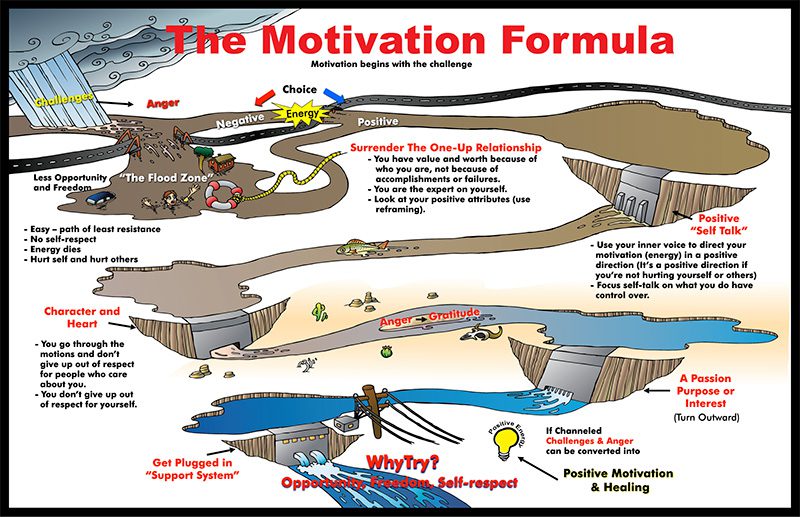
4. Motivation & Resilient Mindset (Motivation Formula)
Hopelessness, discouragement, and a lack of purpose often contribute to substance misuse. This unit encourages students to develop intrinsic motivation, optimism, and persistence through adversity. Facilitators can highlight how setting and pursuing meaningful goals provides a healthier source of satisfaction than drugs or alcohol. By cultivating resilience and teaching students to reframe setbacks, this unit empowers them to choose constructive paths even when life feels overwhelming.
Learning Objectives:
I can be resilient by:
- Using challenges to fuel my motivation.
- Practicing positive self-talk.
- Finding support to help me succeed.
Supporting Skills:
- Healthy relationship boundaries
- Resisting negative peer pressure
- Self-confidence
- Communication skills
- Leadership in groups
- Kindness and Friendship
- Conflict resolution
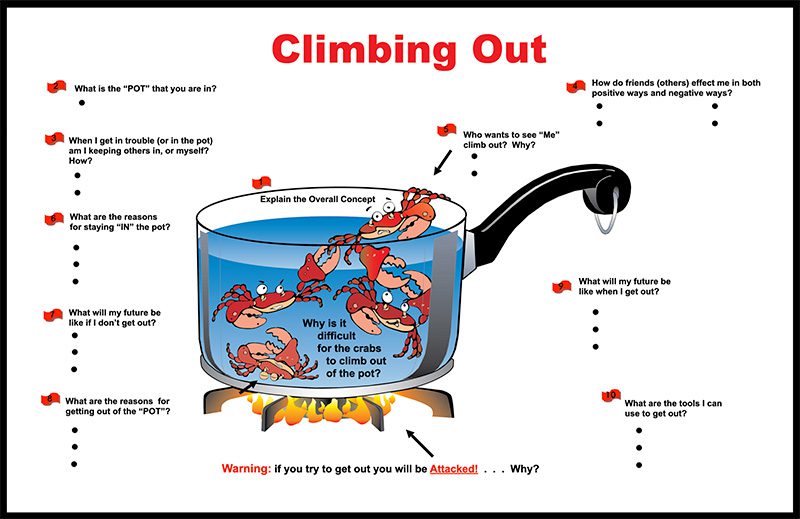
5. Peer Influence & Positive Relationships (Climbing Out)
Peer pressure is one of the strongest predictors of adolescent substance use. This unit equips students with the confidence and communication skills to resist negative influences while building positive, supportive relationships. Facilitators can model and reinforce healthy boundaries, leadership, and kindness, showing students how choosing the right friends and practicing assertiveness protects them from risky behaviors. Strong, prosocial peer networks become a buffer against the lure of substances.
Learning Objectives:
I can be resilient by:
- Recognizing negative peer pressure.
- Choosing positive friends.
- Taking steps to climb out of harmful situations.

Supporting Skills:
- Analyzing problems
- Creative thinking
- Being resourceful
- Willingness to seek help
- Overcoming fear of failure
- Growth mindset
- Perseverance and resilience
- Learning from mistakes
6. Problem-Solving (Jumping Hurdles)
Many students turn to substances when they feel stuck, overwhelmed, or unable to cope with challenges. This unit teaches creative problem-solving, resourcefulness, and the courage to seek help. Facilitators can use it to help students view obstacles as opportunities to learn, rather than reasons to escape through substance use. By normalizing failure and encouraging resilience, students gain confidence in their ability to overcome difficulties without relying on drugs or alcohol.
Learning Objectives:
I can be resilient by:
- Developing problem-solving skills.
- Learning from mistakes.
- Pushing through challenges without giving up.

Supporting Skills:
- Time management
- Work ethic
- Delayed gratification
- Consistency and self-discipline
- Work and task completion
- Goal completion strategies
- Celebrating success
- Intrinsic motivation
7. Hard Work & Determination (Desire, Time, and Effort)
Substance use often appeals to youth seeking quick rewards or instant relief. This unit emphasizes perseverance, delayed gratification, and the satisfaction of achieving goals through effort. Facilitators can connect these lessons to the dangers of seeking “shortcuts” through substances, showing that real success comes from persistence and commitment. Strengthening work ethic and time management helps students focus their energy on positive pursuits, lowering the appeal of risky behaviors.
Learning Objectives:
I can be resilient by:
- Achieving my goals through dedication.
- Putting in the necessary desire, time, and effort.
- Avoiding shortcuts.
Supporting Skills:
- Accountability
- Meeting expectations
- Respecting and following rules
- Self-control
- Integrity
- Valuing routines
- Valuing doing hard things
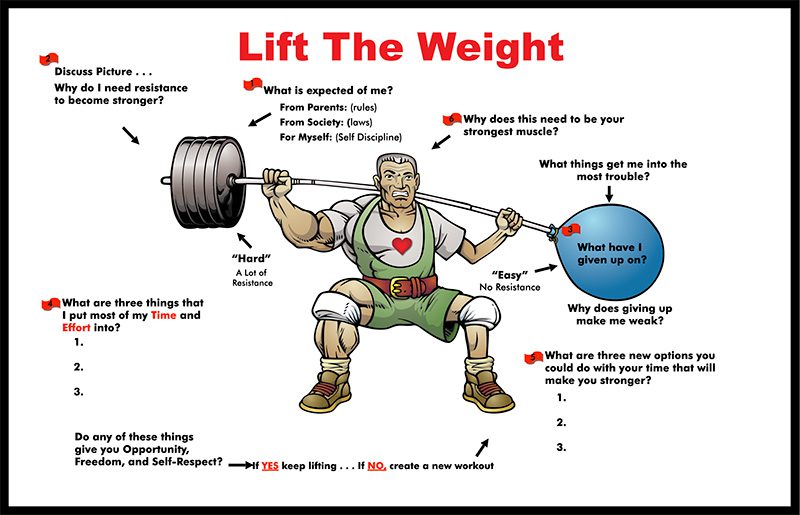
8. Responsibility & Self-Discipline (Lift the Weight)
Substance use often undermines accountability, integrity, and the ability to meet responsibilities. This unit teaches students the value of discipline, honesty, and following through on commitments. Facilitators can frame self-control and accountability as protective tools against risky behavior, helping students see that responsibility is not about restriction but about freedom — the freedom to build trust, achieve goals, and maintain a healthy lifestyle. Developing these traits reduces the likelihood of substance misuse.
Learning Objectives:
I can be resilient by:
- Becoming stronger through following rules.
- Meeting expectations.
- Practicing self-discipline.

Supporting Skills:
- Willingness to seek help and mentorship
- Building trust
- Collaboration
- Intrinsic motivation
- Self-efficacy
- Belonging to a positive community
9. Support Systems & Relationship Building (Plugging In)
Isolation and lack of support are key risk factors for substance use. This unit emphasizes seeking help, building trust, and belonging to a positive community. Facilitators can show students that asking for help is a strength, not a weakness, and that supportive relationships are essential for resilience. By fostering collaboration and mentorship, this unit helps students feel connected and valued, reducing the temptation to turn to substances to cope with loneliness or disconnection.
Learning Objectives:
I can be resilient by:
- Building a strong support system.
- Connecting with positive people.
- Strengthening my relationships.

Supporting Skills:
- Long-term vision and planning
- Purpose and agency
- Growth mindset
- Commitment to goals
- Hope and optimism
- Perspective shift – ability to view challenges differently
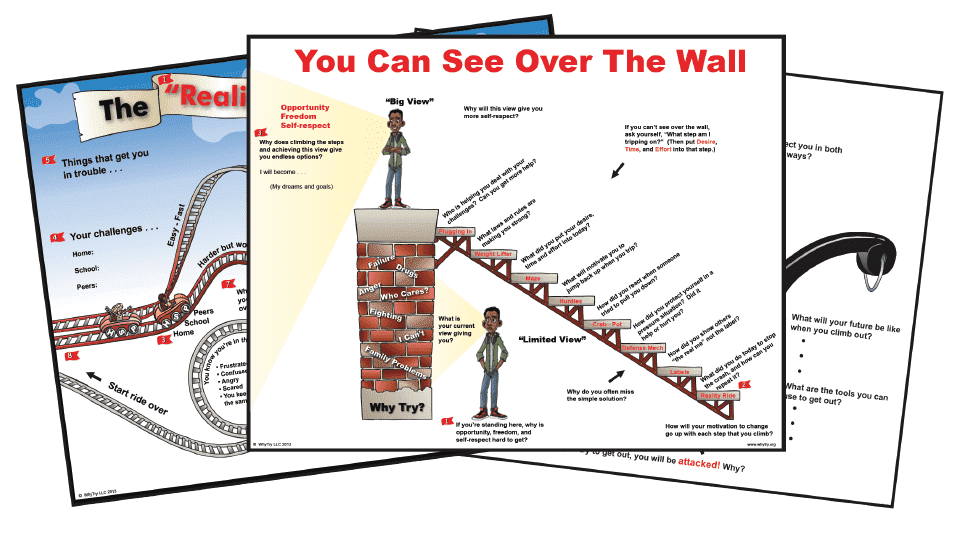
10. Future Ready Vision & Self-Efficacy (The Wall)
Substance use often derails long-term goals and diminishes hope for the future. This unit inspires students to build a vision for their future and believe in their ability to achieve it. Facilitators can highlight how purpose, planning, and self-efficacy act as powerful protective factors, making substance use less appealing. By teaching students to shift perspective and view obstacles as temporary, this unit equips them to stay focused on their dreams rather than escape into risky behaviors.
Learning Objectives:
I can be resilient by:
- Overcoming challenges.
- Shifting my perspective.
- Staying committed to my goals without giving up.
Looking for more details on how it works?
Watch this clip for details on how the WhyTry Program materials and toolkit can be used in your school.
(approx. 9 min)
Success Stories
Lake Chelan School District
Learn how staff, administrators, and students all worked together to improve academic success by combining WhyTry with a peer support network.
Bismarck Public Schools
Learn how Wendy Bakken, a Speech Pathologist at Bismarck High School, uses WhyTry to engage and motivate any student.

Holly Rohrer
Behavior Intervention Specialist, Rudyard Area School District
“We’re a big promoter of PBIS. And because the WhyTry Program has strategies and interventions that align with our goals, we can use it to develop that positive mindset in our students. I feel like they really do combine well together….I think every PBIS school should have some kind of program like this.”

Ashley Wright
Counselor in Houston, TX
“When you can see the purpose of each WhyTry lesson and use the attention grabbers, music, and metaphors to reach the kids with targeted interventions, WhyTry can help you achieve your goals. We saw a significant decrease in the number of referrals.”
Beth Foster
Counselor, Amanda Gist Elementary
“I’m a teacher at heart, and having WhyTry in my toolkit gives me the flexibility to introduce main parts of the program in my guidance classes, and then I can pull in more content as the kids progress through different grades. It works seamlessly for me.”
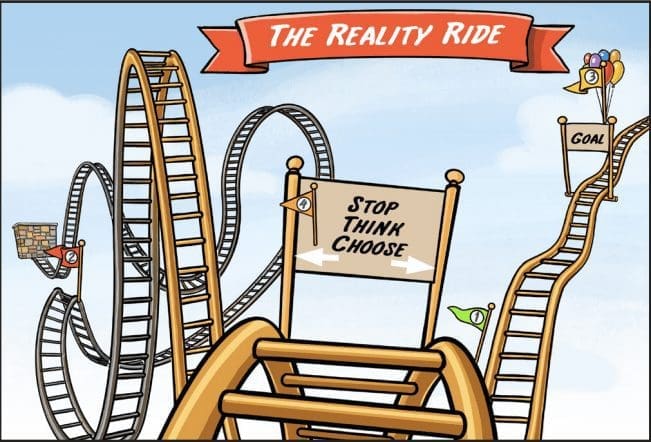
10 WhyTry Learning Units
The WhyTry curriculum utilizes a series often visual analogies that teach essential life skills like:
- Decision-making
- Positive self-esteem
- Emotional regulation
- Having a resilient mindset
- Peer influence & relationships
- Problem-solving
- Hard work & Determination
- Responsibility and expectations
- Relationship building
- Self-efficacy
The Power of Visual Metaphors
One of the most unique things about WhyTry is how we use visual metaphors to teach these important principles to students in a way they can understand and remember. The powerful thing about using this visual approach is the way it takes abstract concepts and puts them into a context through the use of a metaphor that students can understand. It essentially creates a language for educators to communicate the relevance of these things.

Start Where You Are, Work Toward Full-fidelity
Students who participate in a full-fidelity implementation of the WhyTry Program show improvement across several key metrics. To ensure you reap these benefits, we follow a rigorous, yet flexible implementation model. This includes in-person training, online program access, and tools to measure progress both before and after you implement the intervention.